
Blog · How I work
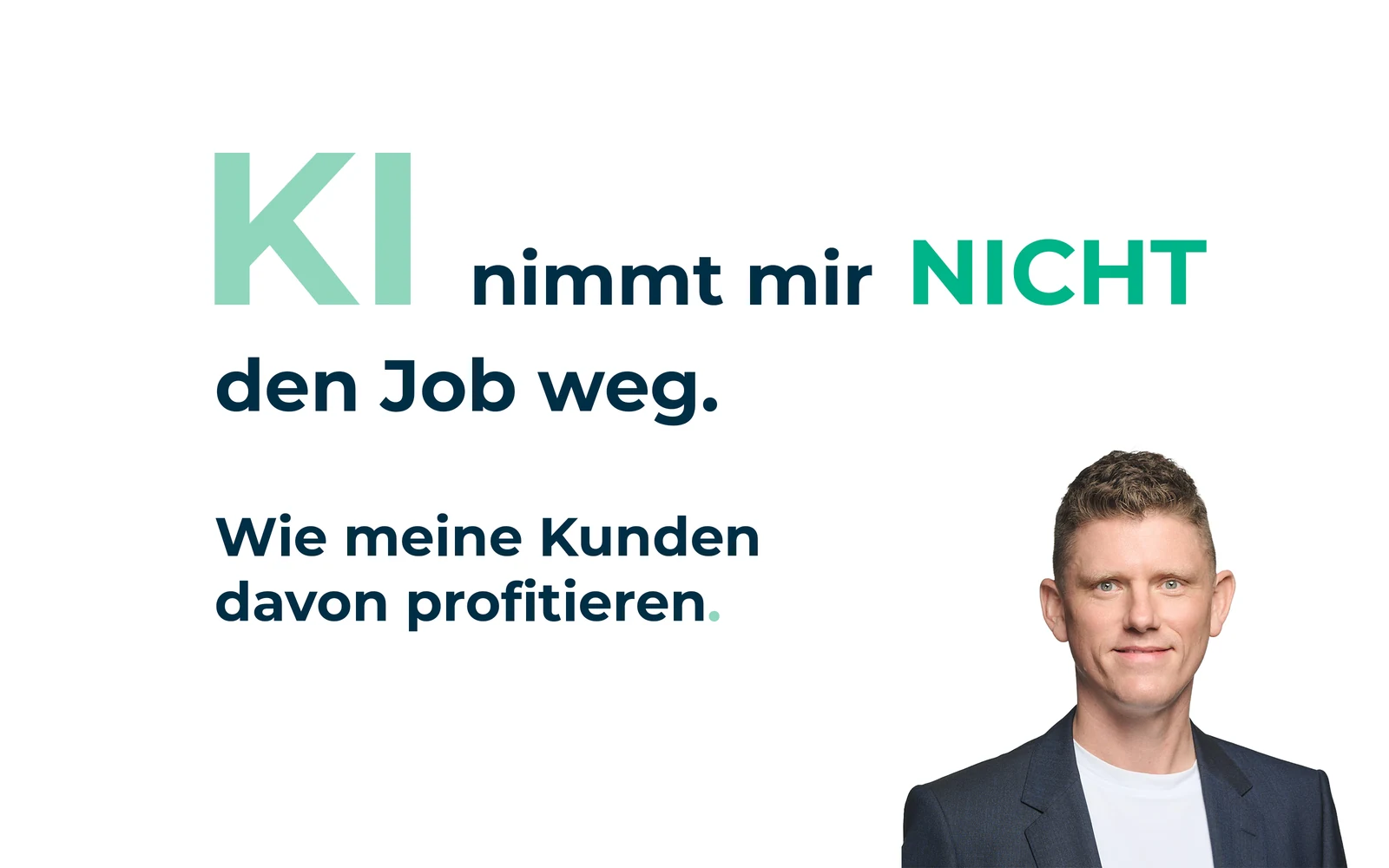
AI isn’t taking my job away. It’s giving me my time back.
Four points for people with 30 seconds to spare
- I’m not afraid of artificial intelligence. I consider it the greatest opportunity this profession has had in years.
- It takes care of the back-office work for me. Organisation, processes, follow-ups. The time this frees up is spent on the people I work for.
- Even before AI, there were people who wanted to do everything themselves. That group is now getting a bit bigger. That’s all there is to it.
- I don’t do mass marketing. Whether four million Germans plan their investments using a chatbot tomorrow won’t change my work in the slightest.
The long version, perfect for one or two cups of coffee.
This question now comes up in almost every introductory call
Usually couched in a friendly, half-finished sentence. Whether what I do will even still exist in ten years’ time.
I understand the question. It comes from people who are currently witnessing how software can write a text in four seconds that would have taken them an hour. Anyone who sees this is bound to think further ahead.
My answer is brief. No, I’m not afraid of that. And that’s not just a case of wishful thinking; there are three quite specific reasons for this.
Reason one: AI makes my work better
I notice this every day. Research that used to take me half a morning is now done in twenty minutes and is more thorough than before. Meeting minutes practically write themselves. Follow-up tasks are generated automatically, rather than me jotting them down in a notebook and then overlooking them.
This website was created in much the same way. To a standard of quality that I could not have afforded three years ago.
The time this frees up doesn’t just disappear. It goes where it belongs: into appointments, into follow-up enquiries, into working on your situation.
For me, artificial intelligence is the engine room. People remain the service. Anyone who reverses this order has not understood the profession.
Reason two: My business thrives on personal contact
I have to be honest here, otherwise it will come across as an advert. Not everyone wants personal contact. It has never been that way.
Long before the advent of artificial intelligence, there were people who didn’t want an intermediary. People who wanted to do it themselves, either out of conviction or because they didn’t want to pay anyone to do it for them. That’s perfectly fine. I’ve never tried to change these people’s minds.
Now this group is growing slightly. Alongside those who do it on their own, there are now those who do it using AI alone. This is a shift, not a landslide.
Because there’s another side to it, too. One of my clients put it to me like that a while ago, and I thought it was a brilliant way of putting it. He’d prefer it if he had a real, flesh-and-blood counterpart right there in front of him. He doesn’t mean that he wants to beat me up. He means that even a video call feels too distant to him, because he comes from a time when people used to meet in the office.
This man will not entrust his protection and his assets to a machine. Not in ten years’ time, and not in twenty.
The comparison I keep coming back to
When the internet arrived and the first booking portals went online, it was a foregone conclusion that travel agencies were on their way out. It was over and done with; in five years’ time, they’d be a thing of the past.
It has affected some people. Particularly those who didn’t want to go with the flow. There are fewer of them in town centres now; that’s true.
They have never gone away. In my home country, those that have remained are now bigger than ever. With new offers, with holidays that cannot be put together in three clicks.
Because the standard product has moved online, and that’s a good thing. If you want a week in Mallorca, you don’t need anyone to help you with that. But the moment it’s no longer off-the-shelf, the moment it becomes something special, you need someone who knows what they’re doing. And in my job, it’s exactly the same.
Reason three: I do not engage in mass marketing
Out of millions of households, I want exactly 246. A small number, chosen deliberately, and by no means a coincidence.
Whether there are three or four million more Germans tomorrow who plan their finances using a chatbot is irrelevant to this model. I don’t need a market share. I need 246 households who want to work in precisely this way.
Those who sell broadly have cause for concern. Those who work in depth do not.
And to my colleagues who are reading this
I know that you’re asked this question too. By clients, by family, and sometimes even by yourselves in the middle of the night.
My advice is uncomfortable. Face up to the issue instead of sitting it out. Embrace technology, get to grips with it, and integrate it into your processes. Those who do so will not be replaced, but will become faster and better.
And then build a business model for those who genuinely want you. Not for those you have to persuade. Specialisation alone is no longer enough; it’s about exclusivity in what you offer and to whom.
Those who chase after those who are unwilling will lose this race. Not against artificial intelligence, but against their own strength.
What remains
Technology takes care of the work that has never been at the heart of my profession. It does not take away the conversation in which someone voices their fears for the very first time. And it does not take away the decision as to whether I advise someone against something, even though it costs me money.
As long as this part remains, I have a job. And my impression is that it is precisely this part that is becoming more important, not less so.
If you’d like to hear from me regularly, subscribe to my newsletter. Professional and personal content, plus commentary on current affairs. Regularly, without any ‘Monopoly weeks’.
Would you like to know what this is like in practice? Then book your free introductory call. I look forward to getting to know you.
Note. This post is my personal assessment as of August 4, 2026, researched and backed by sources I consider reputable. It is general information and does not replace advice that takes your personal situation into account. Laws, products and my own opinion may change.